Government Receipts Explained: 28 Key Terms Every Finance Professional Must Know
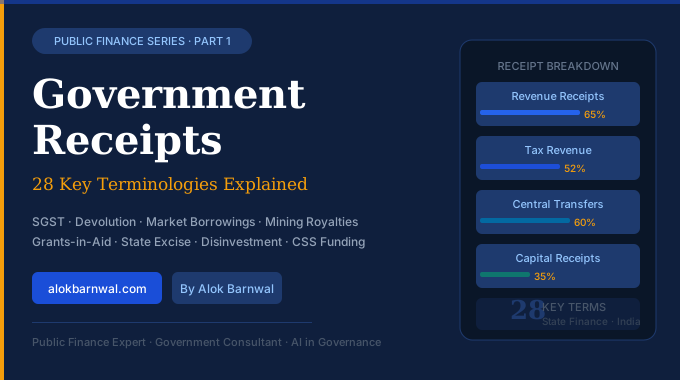
From SGST to Market Borrowings — a complete plain-language guide to how state governments earn money, with real Indian examples.
If you work in government, consulting, or policy — you've seen budget documents filled with terms like "State's Own Tax Revenue," "Devolution," or "Non-Debt Capital Receipts."
Most people nod along. Few actually understand what these mean in practice.
This post breaks down all 28 key terminologies of Government Receipts — the first pillar of public finance — in plain language, with real Indian examples.
What Are Government Receipts?
Government receipts are all the money that flows INTO the government's accounts in a financial year. They fall into two broad categories:
Revenue Receipts — Regular income that does not create any liability or reduce assets. Tax collections, fees, grants — money that comes without repayment obligation.
Capital Receipts — Inflows that either create liabilities (borrowings) or reduce assets (disinvestment).
Part A — Revenue Receipts
1. Revenue Receipts
Regular income received by government that does not create any liability or reduce assets.
Example: Tax collections, fees, grants — money that comes without repayment obligation.
2. State's Own Tax Revenue (SOTR)
Tax revenue collected directly by state government from its own tax sources.
Example: SGST, stamp duty, excise duty, vehicle tax collected by state.
3. State's Own Non-Tax Revenue (SONTR)
Revenue earned by state from services, fees, and returns on investments.
Example: Hospital fees, mining royalties, interest on loans, PSU dividends.
4. Devolution of Central Taxes
Share of central tax revenue transferred to states as per Finance Commission formula.
Example: State receives 41% of divisible central taxes under 15th Finance Commission.
5. Grants-in-Aid from Centre
Non-repayable financial assistance given by Central govt to states for specific purposes.
Example: Disaster relief funds, rural development grants, education sector support.
6. Central Sponsored Schemes (CSS)
Programs funded jointly by Centre and State with defined cost-sharing ratio.
Example: MGNREGA (Centre 100%), PM Awas Yojana (Centre 60%, State 40%).
7. Revenue Receipts as % of GSDP
Ratio measuring state's revenue collection capacity relative to its economic size.
Example: State example: 12.5% in FY23 — indicates fiscal health and tax efficiency.
8. State's Own Resources
Combined total of state's own tax and non-tax revenue collections.
Example: State SOTR + SONTR = Rs 1.2 lakh crore annually.
Part B — Tax Revenue Breakup
9. State GST (SGST)
Tax on intra-state supply of goods and services collected by state government.
Example: 18% GST on Rs 100 purchase: Rs 9 to Centre (CGST), Rs 9 to State (SGST).
10. State Excise Duty
Tax levied on manufacture and sale of alcohol and narcotics within state.
Example: State collects Rs 15,000+ crore annually from liquor excise.
11. Stamp Duty & Registration Fees
Tax on property transactions and document registration charged by state.
Example: 5-7% of property value: Rs 3.5 lakh on Rs 50 lakh flat.
12. Motor Vehicles Tax
Annual or one-time tax on registration and ownership of vehicles.
Example: One-time tax: 8% of car value + annual road tax Rs 2,000–10,000.
13. Land Revenue
Tax levied on agricultural land holders based on land type and productivity.
Example: Rs 50–200 per acre depending on irrigation, soil quality, location.
14. Entertainment Tax
Tax on commercial entertainment activities and events.
Example: Now subsumed in GST; earlier 30% on movie tickets, 20% on events.
15. Tax on Professions, Trades & Callings
Annual levy on professionals and traders for practicing their occupation.
Example: Doctors, lawyers, CAs pay Rs 2,500/year; traders pay based on turnover.
16. Electricity Duty
Tax on electricity consumption or sale collected by state government.
Example: 3–6% duty added to electricity bills: Rs 150 on Rs 3,000 bill.
Part C — Non-Tax Revenue Breakup
17. Interest Receipts
Interest earned by government on loans given to employees, PSUs, and others.
Example: Interest on loans to cooperative societies, municipalities, staff advances.
18. Dividends & Profits from PSUs
Profit distribution received from state public sector undertakings.
Example: State gets dividends from electricity board, transport corp when profitable.
19. Mining Royalties
Revenue from leasing mineral extraction rights to private companies.
Example: Marble, sandstone, gypsum mining generates Rs 3,000+ crore annually.
20. Fees & Service Charges
User charges for government services like licenses, certificates, permissions.
Example: Driving license Rs 200, birth certificate Rs 50, NOC fees Rs 500.
21. Forest Receipts
Revenue from sale of forest produce and timber extraction rights.
Example: Bamboo, tendu leaves, timber sales generate forest revenue.
Part D — Capital Receipts
22. Market Borrowings
Loans raised by state government from market through bonds and securities.
Example: State Development Loans (SDL) at 7–8% interest for infrastructure.
23. Non-Debt Capital Receipts
Capital receipts that don't create liabilities — like disinvestment proceeds.
Example: Selling government land, PSU stake sale, loan recoveries.
24. Transfers from Centre
Total financial assistance flowing from Central to State government.
Example: Tax devolution (41%) + grants + CSS funding = 60% of state receipts.
25. Loans from Government of India
Direct loans from Centre to states — including back-to-back multilateral loans routed through GoI.
26. Small Savings, PF & Other Deposits
Funds mobilised through small savings schemes and provident fund contributions.
27. Disinvestment Proceeds
Revenue from selling government stake in PSUs — partial or full divestment.
28. Growth Rate of Revenue
Percentage change in revenue receipts compared to previous year.
Example: Revenue FY23: Rs 1.2L cr, FY24: Rs 1.35L cr = 12.5% growth rate.
Why Does This Matter?
Understanding the receipt side of a budget tells you:
- How dependent a state is on Central transfers
- How buoyant its own tax base is
- How much borrowing it needs
- Whether its debt is sustainable
The CAG regularly audits these receipts and flags irregularities — like inflation of revenue receipts where unclaimed deposits are incorrectly booked as income.
Download the Full Carousel
Want a quick visual reference? Download the PDF carousel — all 28 terms in one shareable slide deck.
👉 Download Part-1 Full PDF → Click Here
What's Next in This Series?
- Part 2: Government Expenditure — 23 terms
- Part 3: Deficits & Surpluses — 11 indicators
- Part 4: Debt & Liabilities — 18 terms
- Part 5: FRBM Compliance — 10 terms